Howard 28 Bullet Review
Howard 28 Bullet is Immaculate and set high standard for sport boats.
August 8, 2007
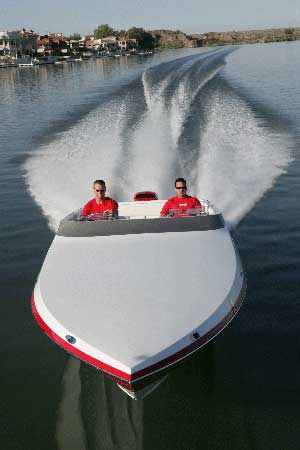
Howard hooked the engine up to a Bravo One XR drive with a 1.5:1 gear ratio and a 32"-pitch Mercury Racing Bravo One propeller. With that setup, our Test Team squeezed out a top speed of 89.4 mph at 5,400 rpm on radar.
There aren't too many boats that we've had the pleasure of testing with an extremely wide range of power. One exception is the top-selling boat from Howard Custom Boats—the 28 Bullet.
We've tested a half-dozen or so variations of the 28-foot sport boat since the Valencia, Calif., builder introduced it in 1999, and three times the boat has taken home the magazine's Sport Boat of the Year honors. With single-engine packages ranging from 425 to 1,100 horsepower, the 28 Bullet's performance has always impressed our Test Team.
This time, Howard delivered a 600-hp, closed-deck edition to the Parker, Ariz., leg of our Performance Trials, and it didn't disappoint.
Performance
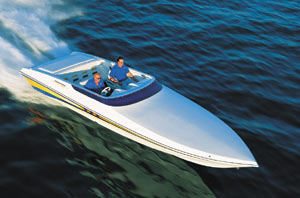
In our first go-around with a Mercury Racing HP600SCi power plant in the 28 Bullet, the production mill provided nice punch in the single-step V-bottom designed by Howard's General Manager Mike Willen. The boat tracked perfectly at all speeds and never got upset by the 1- to 2-foot river chop.
The boat, which checked in at $140,200, was smooth through the turns and slaloms, maintaining an even attitude throughout. During higher-speed turns, our lead test driver did have to back off the throttles a bit.
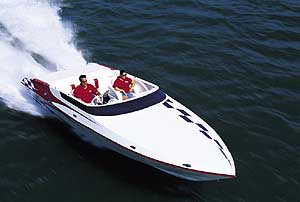
Howard hooked the engine up to a Bravo One XR drive with a 1.5:1 gear ratio and a 32"-pitch Mercury Racing Bravo One propeller. With that setup, our Test Team squeezed out a top speed of 89.4 mph at 5,400 rpm on radar. Our lead test driver believed the boat would top 90 mph in less breezy conditions, but he was still impressed with how the boat handled the supercharged package.
The acceleration of the 28 Bullet was acceptable, although the top-end fell a little short of our expectations. The V-bottom took 9.5 seconds to run from 40 to 70 mph, while the 40-to-60-mph drill took 5.7 seconds. From a standing start, the sport boat reached 50 mph in 10 seconds, the same speed it ran while cruising at 3,000 rpm.
Time to plane (5.1 seconds) was the same with or without the Dana Marine HP900 trim tabs down. Fuel efficiency was reasonable as the 28 Bullet got more than 2.5 mpg at 40 and 50 mph, and at wide-open throttle was still better than 1.7 mpg.
Workmanship
While the performance usually steals the show, the builder's workmanship always comes in a close second. The tooling and gelcoat work on this year's 28 Bullet was once again next to perfect.
Laid up with vinylester resin, Knytex and bi- and tri-directional knitted glass, the builder also used Decolite panels at the bulkheads to reduce weight in the 28-footer that tipped the scales at 4,800 pounds. All deck hardware, which consisted of six Accon Pull-Up cleats, twin fuel caps, cat-eye navigation lights and billet grab handles on the built-in swim platform, was stainless steel.
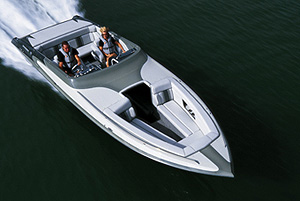
The in-gelcoat red and gray graphics were protected by a stainless-steel rubrail that was neatly installed. And the all-white deck was impeccable—we couldn't find a single blemish no matter how hard we looked.
The clean appearance carried into the engine compartment that opened on Dana Marine hydraulic hinges. The underside of the hatch was a metallic gun metal, and the bilge and transom were painted to match. To provide clearance for the motor, a scoop was integrated into the hatch.
Howard included a pair of fiberglass-molded fender holders on each side of the engine. All the wiring was gathered and tie-wrapped precisely, which always pleases our workmanship inspector. The engine was installed using Mercury race mounts attached to L-angles through-bolted to the stringers.
Interior
Howard owner Gene Willen said he's seen a resurgence in the closed-deck 28 Bullet. In the past, the company produced four open-bow models for every closed-deck model. That changed in 2006, and Willen said it has to do with his customers putting high-horsepower engines in the V-bottom.
The closed-deck version had a spacious cabin with a V-berth and two facing lounges. Just ahead of the port-side lounge was a strapped-down cooler. The builder also included a head compartment underneath the V-berth's forward cushion.
In the cockpit, Howard installed gray snap-in Berber-style carpet that matched the gray panels on the wide bolster seats and rear bench. Padding on all the seats and the gunwales was ample, and the pewter billet seat bases provided a footrest for rear passengers. Grab handles were also mounted to the back of the bolsters to give those in the back something to hold onto at high speed.
At the helm, the 28 Bullet featured a pewter Livorsi Marine throttle and shifter mounted on an extension from the gunwale. Ahead was a column of rocker switches with trim indicators mounted above on the gunwale. The positioning of the indicators made them somewhat difficult to see.
Sitting up high on the dash at an angle were two Auto Meter Pro-Comp Marine Monster gauges for the speed and tachometer and a Livorsi compass, all in chrome bezels. A row of smaller gauges was mounted below, just above the IMCO Marine tilt steering wheel.
Howard installed a glove box in front of the co-pilot, as well as a grab handle on the gunwale. Stowage within the cockpit included cutouts in the gunwales behind the driver and co-pilot and compartments under the rear bench cushions.
Overall
From top speed to high-quality production, Howard's 28 Bullet impressed us again. No matter the engine package, the V-bottom always responds. The 28-footer may come with a higher price tag than other boats in its class, but it's worth every penny.